
In This Article
A Familiar Myth, Reframed
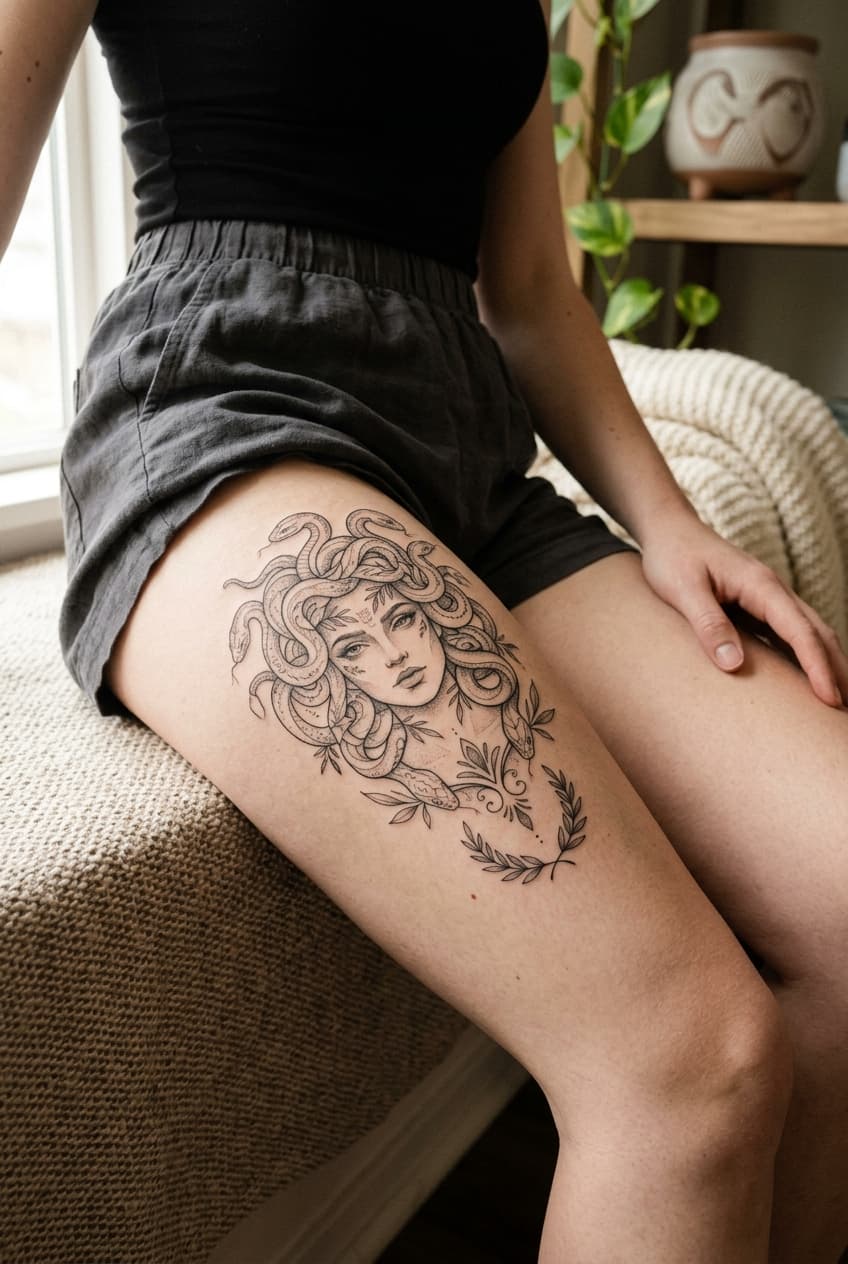
This piece renders Medusa as a clean, single-needle line art portrait — snake hair included — a style choice that keeps the focus on her face and expression rather than a heavily shaded, monstrous depiction.
Medusa as Protector, Not Monster
In the original Greek myth, Medusa was cursed and turned into a monster whose gaze turned onlookers to stone. In recent years, tattoo clients have increasingly reclaimed her image as a symbol of protection and survivor strength rather than villainy — someone who was punished unjustly and turned that pain into power.
It's now one of the most requested feminine-power symbols we tattoo, often chosen to mark resilience after a difficult period.
The Fine-Line Portrait Technique
Portrait line art like this relies on careful proportion work to keep the face recognizable using only outline — there's no shading to hide small errors in the features, so the stencil and linework have to be precise from the first pass. The snake hair adds detail and movement without competing with the facial linework.
Placement for a Portrait Composition
Because the design reads as a vertical portrait, the ribs, outer thigh, or forearm all work well — anywhere with enough length to let the snake hair extend naturally above and below the face.
Frequently Asked Questions
Why do people choose Medusa specifically as a symbol of strength?
Many clients connect with the modern reinterpretation of Medusa as someone wrongly punished who turned her curse into protective power — a popular symbol for resilience after hardship.
Does fine-line portrait work age differently than shaded portraits?
Line-only portraits can actually age more predictably than heavily shaded ones, since there's less gradient to soften — though line spacing still needs to be planned carefully to avoid blurring over time.


